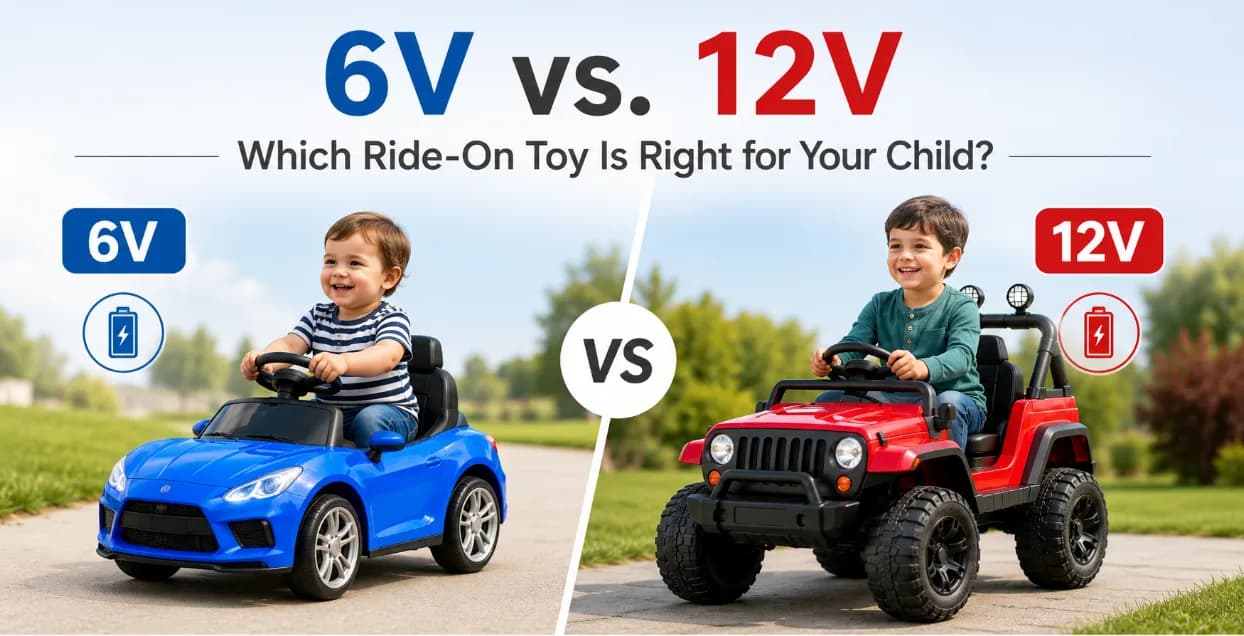
If you've started shopping for a battery-operated ride-on toy, you've probably noticed the "6V" or "12V" label on almost every product listing — often without much explanation of what it actually means for your child. Voltage isn't just a technical spec; it directly affects speed, weight capacity, ride experience, and safety. Here's everything you need to know to choose the right one.
What Does Voltage Actually Mean?
The voltage (6V, 12V, and sometimes 24V) refers to the power output of the battery that drives the vehicle's motor. In simple terms: higher voltage means more power, which means higher speed and stronger performance.
6V toys are entry-level, low-power vehicles built for gentle, controlled movement.
12V toys offer noticeably more speed, torque, and the ability to handle rougher terrain or heavier riders.
6V Ride-On Toys: The Basics
Best for: Ages 1–3
Typical top speed: 1–2 mph
6V ride-ons are designed for a child's very first experience with a powered vehicle. They're intentionally slow and simple, prioritizing safety and ease of control over performance.
Pros
Very low speed, ideal for beginners and toddlers still developing coordination
Lighter overall vehicle weight, easier for parents to carry or store
Usually simpler controls (often just forward, sometimes reverse)
Generally more affordable
Smaller battery means shorter charging time
Cons
Limited to smooth, flat indoor or paved surfaces — struggles on grass or uneven ground
Lower weight capacity, so kids will outgrow it quickly
Less powerful motor can feel underwhelming to slightly older kids
12V Ride-On Toys: The Basics
Best for: Ages 3–8
Typical top speed: 3–5 mph
12V vehicles step things up considerably. They're built with sturdier frames, stronger motors, and often more realistic features like working lights, horns, and multiple speed settings.
Pros
Higher weight capacity, so the toy lasts through more growth stages
Stronger motor handles grass, gravel, and mild inclines
Often includes extra features: parent remote control, multiple gears, MP3/Bluetooth connectivity
More realistic ride experience with suspension and larger wheels on many models
Cons
Faster speeds require closer supervision, especially for younger or first-time riders
Heavier vehicle, harder to lift and store
Longer charging times and typically higher price point
May be too fast or intimidating for very young toddlers
Side-by-Side Comparison
Feature | 6V | 12V |
Recommended Age | 1–3 years | 3–8 years |
Top Speed | 1–2 mph | 3–5 mph |
Best Terrain | Smooth indoor/paved surfaces | Grass, gravel, mild inclines |
Weight Capacity | Lower | Higher |
Features | Basic (forward/reverse) | Advanced (lights, horn, multiple gears, remote) |
Charging Time | Shorter | Longer |
Price Range | Budget-friendly | Mid to premium |
How to Decide: Key Questions to Ask
How old is your child, and how steady are they on their feet? If they're still mastering walking and basic coordination, a 6V toy offers a safer, slower introduction.
Where will they mostly ride it? Smooth indoor floors and driveways favor 6V. Backyards with grass or uneven ground call for the extra power of a 12V.
Do you want the toy to "grow" with your child? 12V vehicles tend to have higher weight limits, meaning your child can keep using it for a longer stretch of years.
How closely can you supervise? 12V toys move faster and often come with a parent remote control — a useful safety feature if you want to override speed and direction while your child gets comfortable.
What's your budget? 6V toys are generally the more affordable entry point, while 12V vehicles cost more upfront but often last longer due to higher durability and weight capacity.
A Quick Note on 24V and Beyond
For children closer to 8+ or those who've outgrown a 12V, some brands offer 24V ride-ons with even higher speeds (up to 8-10 mph) and more advanced features. These are best reserved for older, more experienced riders and larger outdoor spaces.
The Bottom Line
There's no universal "better" option — the right voltage depends entirely on your child's age, riding environment, and how much power feels appropriate for their skill level. As a general rule of thumb:
Choose 6V for a toddler's first ride-on experience, especially for indoor or smooth-surface use.
Choose 12V for a child who's ready for more speed, more terrain, and a toy that will keep up with them for a few years.
Whichever you choose, always prioritize proper supervision, a safe riding area, and gradual speed increases as your child builds confidence and skill.
Not sure which model fits your child best? Check out our full gift guide for age-specific ride-on toy recommendations, plus our care guide to keep your battery-powered vehicle running longer.